|
By Shibil Siddiqi
This post was originally published by Legal Aid Ontario as part of the Personal perspectives on access to justice series. Access to justice Traditionally access to justice has been seen as providing access to dispute resolution tools, including effective access to courts and tribunals. No one should have to lose their liberty, family, residency status, home or source of income without a fair shot at due process. With dispute resolution effective access is key, and necessarily includes the provision of competent legal services to ensure that parties to a dispute can navigate the technical requirements and barriers established by a formal dispute resolution mechanism such as the justice system.
0 Comments
Legal clinics are looking at how we can improve our services. We believe we can give clients more service, more access to justice and provide it closer to home.
Here are some of our main ideas:
Court Divided on Charter Right to Housing, Claimants Will Appeal
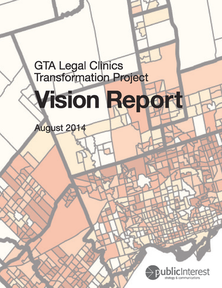
(Toronto) - Today, the Ontario Court of Appeal released a divided ruling to homeless and inadequately housed Canadians in a landmark Charter challenge against the federal and provincial governments. In a strong dissent, Justice Kathryn Feldman, the most experienced judge on the panel, found that the application raises serious Charter claims of significant public importance. The GTA Legal Clinics’ Transformation Project has released its Vision Report: a report that spells out how geographically based community legal clinics in the GTA can be reorganized to provide more and better services to our client community.
The following is Neighbourhood Legal Services' submissions to the Land Use Planning and Appeal System Consultation. It urges the Ontario Government to boost the accountability of its Land Use Planning system by including the review of housing and anti-homelessness policies within the jurisdiction of the Ontario Municipal Board. These submissions were prepared by Ben Ries, one of the lawyers at NLS.
This year NLS is marking its 40th year of providing legal services to the low income residents of Toronto’s downtown east side. Only a few in the community now will recall that day in 1973 when the clinic opened its door in a house on Seaton Street. While the community has changed and continues to change in what is really a process of continual renewal, the basic legal needs the clinic addresses have not changed much. Fighting through the Courts and Tribunals, through law reform campaigns and through outreach and public legal education for better and more secure housing, better and more secure incomes and more secure status in Canada for immigrants and their families has been the mainstay of our work throughout the past 4 decades.
In a lengthy 52 page decision released on Friday, September 6, Mr. Justice Thomas Lederer of the Superior Court of Ontario dismissed the landmark ‘Right to Housing’ case that had been brought by the Advocacy Centre for Tenants Ontario (ACTO) and other housing and homelessness advocates.
The state of access to justice in Canada is "abysmal," according to an in-depth study commissioned by the Canadian Bar Association (CBA), with profound inequalities in quality of justice depending on income levels.
The CBA launched its Envisioning Equal Justice initiative in August of 2012 to look at the problem and more importantly, start developing ways to balance the scales. At the 2013 CBA Legal Conference in Saskatoon the Access to Justice Committee released "Reaching Equal Justice: An Invitation to Envision and Act," a summary of the larger position paper that will be released this fall. You can read the summary report here. |
The NLS BlogOur blog shares information with our community on legal developments and other important issues. As such we hope you'll find this blog informative - and maybe even fun. Categories
All
|